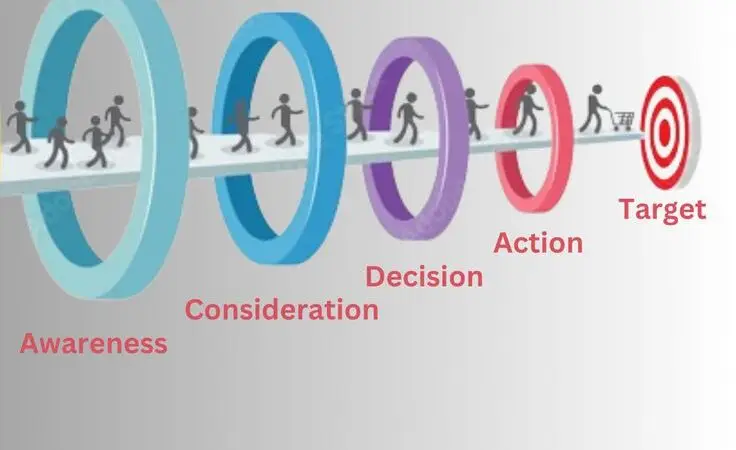
The Volume Trap: Why ‘More Lead Gen’ is Often a Faulty Diagnostic
Type your paragraph hereWhen first trade dates slide or major enterprise deals slip into the next fiscal quarter, the corporate response is almost entirely predictable. The board demands action, and the executive suite translates that pressure into a singular directive: increase top-of-funnel volume.
This is the classic manifestation of Ambition overriding Alignment.
Ambition is the relentless, brute-force push for more—more headcount, more leads, more activity. It is driven by the assumption that growth is purely a KPI maths problem solved by scale.
Alignment, however, is entirely different. Alignment is the architectural rigor that ensures your proposition, your sales stages, and your buyer’s actual decision criteria are perfectly synchronised.
When you treat a conversion block as a volume deficiency, you fall into the Volume Trap. If your funnel conversion factors are structurally broken, pouring more leads into the top of the funnel doesn’t yield more revenue. It simply accelerates your inefficiency, burns cash, and exhausts your sales team under the weight of operational noise.
The GTM Anchor: We design frameworks for complex, high-value enterprise sales. We do not design or support “volume-at-all-costs” growth models. Sustainable scale is a product of structural precision, not pipeline chaos.
The 3 Step Funnel Operational Diagnostic Review
Before authorising a single pound of budget for new lead generation, enterprise leaders must run a strict diagnostic review on their existing mid-funnel mechanics. Focus your diagnostic on three critical operational choke points:
1. The Decision Process Disconnect (The “Validation” Phase)
Most pipeline friction occurs not because the client lacks interest, but because the vendor does not understand how the client actually buys.
– The Diagnostic: Audit your active pipeline to see if your sales team has mapped the internal legal, compliance, and procurement pathways of the prospect.
– The Real-Time Indicator: If “Agreement in Principle” stages are stretching past 45 days, your team is likely selling to an champion who lacks the structural authority to navigate their own company’s procurement engine.
2. The Value-Asymmetry Factor
As a deal progresses to the mid-funnel, the buying group expands from technical users to financial gatekeepers. If your messaging remains focused on feature benefits rather than hard business cases, the deal stalls.
– The Diagnostic: Review your mid-stage sales collateral and business cases. Do they articulate ROI in the specific language of the CFO (e.g., impact on EBITDA, working capital efficiency, risk mitigation)?
– The Real-Time Indicator: If deals stall immediately after the initial demo or technical presentation, your team is failing to translate technical validation into economic justification.
3. The Qualification of Inaction (The “No Decision” Threat)
In enterprise sales, your fiercest competitor is rarely another vendor; it is the status quo. “No decision” is the silent killer of enterprise pipeline.
– The Diagnostic: Analyze historical closed-lost data. What percentage of deals were lost to a competitor versus lost to “do nothing” or “deferred”?
– The Real-Time Indicator: If more than 30% of lost opportunities ended in inaction, your qualifying criteria are too soft. Your team is spending expensive pre-sales resources on opportunities that lack a compelling event or a cost of inaction (COI) high enough to force change.
Shifting from Brute Force to Strategic Alignment
Resolving the friction in your sales pipeline is rarely a top-of-funnel problem. It is almost always a structural design problem.
If your organization is ready to move away from chaotic volume loops and build a highly predictable, enterprise-grade GTM engine, we should talk. Let’s align your strategy before you fund your ambition.